












Last updated: September 14, 2026
A garter belt looks simple until you're standing in front of a mirror trying to work out which strap goes where, and why the band keeps sliding up. It's one of those pieces people buy once, wear once, and then leave in a drawer, not because it doesn't suit them but because nobody explained how it works. This guide covers what a garter belt is, how it differs from leg garters, how it should fit, and how to put one on so it stays put instead of fighting you all night.
Key Takeaways
- A garter belt sits at the natural waist and holds stockings up with adjustable straps and metal clips. Leg garters skip the belt entirely and hold stockings up with elastic gripping the thigh alone.
- Fit lives in two places: the waistband, which should be snug without digging in, and the strap length, adjusted so the stocking top sits flat instead of twisted or pulled.
- Four straps cover most everyday wear. Six straps add stability for a fuller thigh or a full day on your feet.
- Put stockings on first, fasten the belt second, and clip through the reinforced welt at the stocking's top edge, never through the sheer panel itself.
- A garter belt doesn't need stockings underneath at all. Worn on its own over clothing or under an open layer, it functions as a waist accessory.
What Is a Garter Belt, Exactly?
A garter belt is a band worn at the waist with straps that hang down and clip onto the tops of stockings, holding them in place through tension at the waist rather than elastic gripping the leg. The name is regional more than functional: in the UK it's usually called a suspender belt, in the US a garter belt, and both describe the same construction.
The garter belt as we know it came out of a practical fix, not a design idea. The Underpinnings Museum holds silk "hose supporters" from 1890s America, pinned directly to a corset with straps reaching just above the knee, the earliest documented step away from tying garters straight onto the leg, as detailed in the museum's own collection notes.
A modern garter belt doesn't need a corset underneath it. Most, including ours, are structural enough to hold their shape on their own, with elastic paneling, boning-adjacent structure, or a wider satin band doing the work a corset used to do. Browse the full range in our garter belt collection to see how much variation sits inside that one basic mechanic.
Garter Belt vs. Leg Garters: Which One Do You Actually Need?
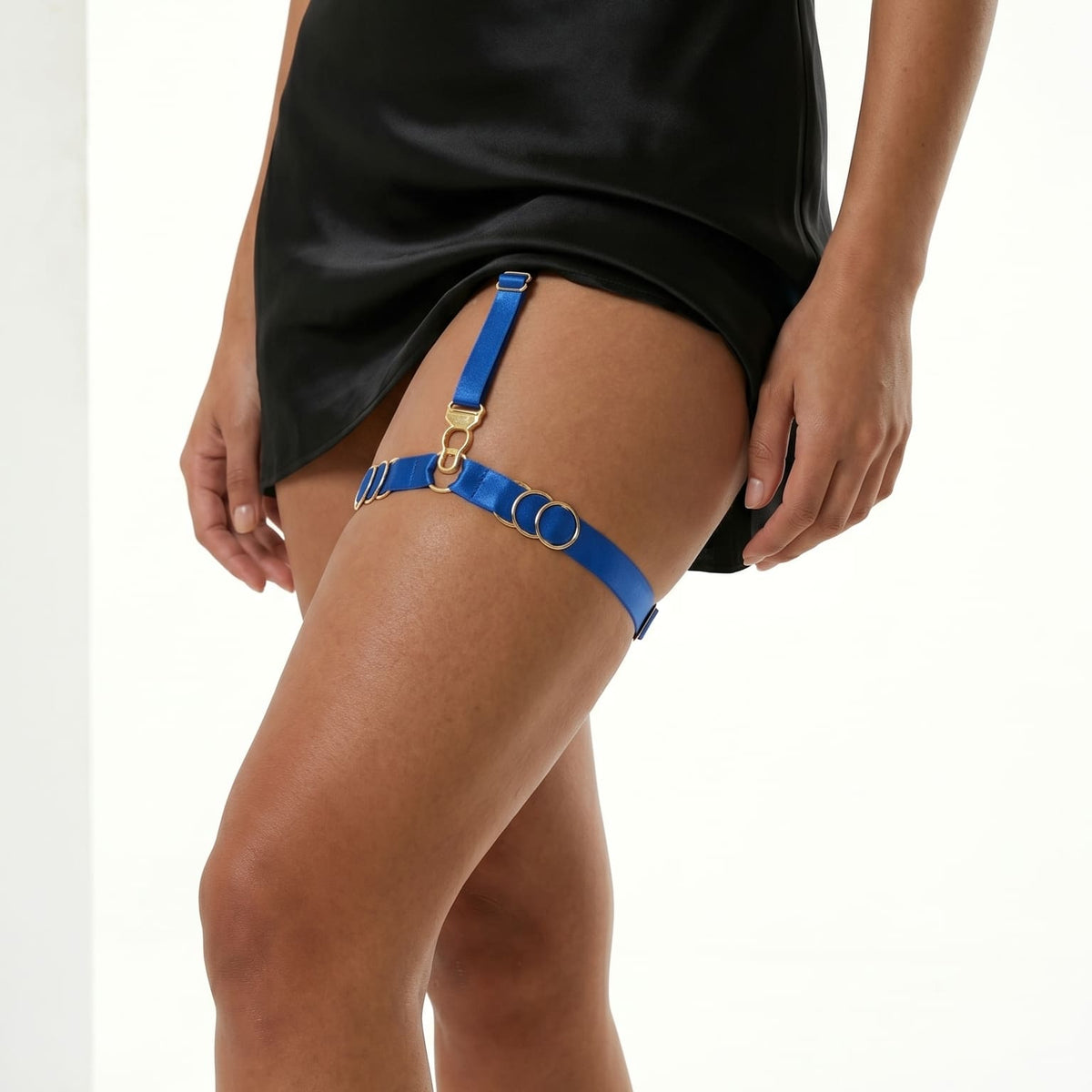
A garter belt holds stockings up through tension distributed across a waistband. Leg garters hold stockings up through elastic gripping the thigh directly, with no belt at all. Neither is more "correct." They solve the same problem two different ways.
Leg garters, like our Simple and Quartet lines, go on in seconds and stay invisible under fitted trousers or a pencil skirt, since there's no waistband to show through fabric. The trade-off: the elastic sits directly against skin, and if it's tight enough to hold a stocking all day, it can leave a mark by evening. There's also no strap to adjust once it's on, so the size has to be right from the start.
A garter belt spreads the same tension across a wider band instead of one point on the thigh, which is why it holds mid-thigh and higher stockings more reliably over a long day, and why it works better under a skirt or dress than under trousers. It also does something leg garters can't: work as a visible piece on its own, the styling angle covered further down. See the full leg garter collection if invisibility under clothing matters more to you than styling.
How to Wear a Garter Belt, Step by Step
Stockings go on before the belt, not after. Pull them up unclipped so the fabric sits smooth, with the reinforced welt at the top sitting flat against your thigh rather than rolled.
- Fasten the belt at your natural waist, the narrowest point of your torso, the same place a high-waisted brief would sit. Not lower, on the hip, where the straps won't reach the stocking tops without pulling.
- Clip the front straps first, then reach back for the rear ones. Working front to back keeps you from twisting the belt around your waist while you're still adjusting.
- Adjust each strap's slider so the stocking top sits flat against your leg. Too short and it pulls the stocking (and the belt) upward; too long and the stocking sags and rolls.
- Check the fit both standing and seated. A strap that looks right standing can go tight or slack the moment you sit down, and that's the position you'll actually spend most of the evening in.

How a Garter Belt Should Fit
A well-fitting garter belt stays in place at the waist without you touching it, and the straps are long enough that the stocking sits flat instead of pulled taut. Most fit problems come from one of those two measurements being off, not both.
Size the waistband to your actual waist, not your hip. A belt sized to the hip sits too low to reach the stocking tops without tension, which is what causes the whole thing to creep upward over an evening. Our garter belts close with adjustable hooks, giving a small range to work with, but starting from the correct waist measurement matters more than the range itself.
If the band keeps riding up no matter how you adjust the straps, the waist size is too large. If the stocking top visibly pulls or the fabric bunches at the clip, lengthen the strap rather than loosening the belt. Two different symptoms, two different fixes.
Choosing a Style: Strap Count, Band Width, and Hardware
Four straps, two front and two back, cover most everyday wear and most stocking styles. Six straps add a second attachment point on each leg, which spreads the load further and holds better through a long day or an evening that involves a lot of sitting and standing.
Band width is a comfort and structure trade-off more than a style one. A narrower band moves with you and disappears under most clothing; a wider structural band, like the ones in our Kleo and Emerland collections, holds its shape on its own and reads as a design piece rather than a purely functional layer underneath something else.
Hardware, the rings, geometric cutouts, and clip finishes, is where a garter belt stops being purely functional and starts being something worth showing on purpose. That distinction matters once you get to styling it outside its original job, covered next.

Styling a Garter Belt for Different Occasions
Under a wedding dress, a garter belt does the same job it does anywhere else: it holds stockings up. What changes is the color logic and the odds someone actually sees it. Our guides on bridal lingerie basics and the wedding night specifically cover the color and set-building decisions in more depth than this piece does. Our bridal collection pairs most garter belts with a matching set for a coordinated look.
Under everyday clothing, a lower-profile band worn under trousers or a fitted skirt is invisible unless someone's looking for it, which is exactly the point for most day-to-day wear.
As a visible layer, worn over an open shirt, under a blazer left unbuttoned, or as the accessory that finishes off a going-out look, a garter belt does a completely different job: it's a waist accent, not hosiery hardware. We've covered this styling direction at more length in how to style lingerie as outerwear and in the backless-dress context in what to wear under a backless dress, since a garter belt is one of the few pieces with nothing to hide once there's no back panel left to cover it.

Common Garter Belt Mistakes
- Sizing to hip measurement instead of waist, which sets up the riding-up problem before you've clipped a stocking.
- Clipping through the sheer part of the stocking instead of the reinforced welt at the top, which tears the fabric and rarely holds anyway.
- Buying leg garters when you need the hold a full belt gives, or the reverse: buying a garter belt when you only wanted the styling and never plan to wear stockings with it.
- Checking fit standing only. Sit down before you decide anything is too tight or too loose.
Caring for Your Garter Belt
Hand wash in cool water, and keep the metal clips out of a washing machine drum entirely, since they snag on other fabric and the friction wears the plating faster than normal use ever would. For the actual wash steps, lace and hardware handling, and drying method, our full guide on how to wash lingerie the right way covers it in detail rather than repeating it here.
Frequently Asked Questions
Do you wear a garter belt over or under your underwear?
A garter belt sits at the waist as its own layer. Most people wear a separate pair of panties underneath it, with the garter belt's straps running down over the hip to the stocking tops rather than under any other garment.
Can you wear a garter belt without stockings?
Yes. Worn on its own, especially a structural style with visible hardware, a garter belt works as a waist accessory rather than hosiery hardware. The straps simply hang loose or clip to nothing.
What's the difference between a garter belt and a suspender belt?
Nothing structural. "Suspender belt" is the UK term and "garter belt" is the US term for the same piece. In the UK, "suspenders" refers to what Americans call garters.
How many straps does a garter belt need?
Four is standard and enough for most everyday wear. Six adds a second attachment point per leg for extra stability through a long day or a lot of sitting and standing.
Can a garter belt be worn under everyday clothing?
Yes, as long as the band is a lower-profile style. A narrow band sits flat enough under trousers or a fitted skirt that it won't show through the fabric.
Written by Lioness Studio. We design and hand-finish every piece in small batches, made to the measurements you give us rather than pulled from a standing size run.